

 Leveraging technology is essential for contractors to stay competitive and grow in the modern era. As the Inside Sales Manager for Alchemy-Spetec, I have the daunting task of maintaining our ever-increasing lead, customer, and project database. There is no room for hesitation in today’s competitive landscape, and we need easily accessible, precise information at a moment’s notice. Organizing your day-to-day tasks with a CRM (Customer Relationship Management) system can give you a powerful, painless, and rapid advantage over the competition.
Centralize Data & Information
We all at some point have likely had to contend with endless emails, spreadsheets, and documents siloing or isolating important data and information about our leads and customers. With a CRM, you can integrate your data into one single source of information. You can use it to manage customer data and leads as they enter your pipeline through various channels and integrate them into a linear sales process.
Increase Productivity & Results
Enable your entire sales and marketing team to get more done. Leads can be tracked through a linear sales process with access to information displaying critical data points for whatever the user needs. Having a centralized database reduces your paperwork and helps you limit the headache of digging through old emails. With a clear view of your leads and customers to access at any time, you will be able to focus on execution instead of endless email chains and spreadsheets.
Clear Reporting and Greater Visibility
With CRM dashboards and reporting features, your team and management will be able to make key decisions to improve and scale the business. You'll be able to quickly identify inefficiencies and take swift action to address them. Real-time reporting allows you to quickly assess what is going on and how the health of the business is looking without having to rely on exporting and aggregating data on a spreadsheet over and over. I can’t stress enough the importance of being able to quickly and efficiently generate sales forecasts and analyze the profitability of your various service offerings.
Contact Us for CRM Tips and Guidance
Please contact me (David Park - Inside Sales Manager) at dpark@alchemy-spetec.com if you have any questions or need technical guidance on choosing or using a CRM.
Want more information on Alchemy-Spetec products?



 Episode 14 of
 If you run a contracting business, you're probably handling hundreds of tasks on a daily basis with a limited and overworked team. Not only is it overwhelming, but key action items like lead follow-up or estimate requests fall through the cracks leading to more time wasted backtracking them later. Luckily, automation software like
 Sewers can be aggressive to downright hostile environments for concrete. Composite and fiberglass manholes are becoming more popular due to their superior resistance to sewer gases. While chemically resistant, composite manholes still have penetrations and joints. And any structure with penetrations and joints is still susceptible to infiltration.
 When parts of a concrete surface sink due to erosion and poor compaction, the resulting trip hazard can be dangerous. If left unrepaired, liability and safety issues linger. Although concrete is tough and durable, unstable soil can cause it to crack and sink. Fortunately, a reliable solution for lifting concrete has been developed and proven over the past few decades. High-strength expansive polyurethane foam is injected underneath the slab to bring it back to level. This method has been used in a wide variety of commercial and residential applications with long-lasting results.

 Many spray foam insulation installers are interested in adding slab lifting capability to their rig setup. If you're a spray foam installer considering slab lifting, we have all the info you need right here. With just four additional pieces of equipment and one set of material, you can add slab lifting to your service offerings. Let’s take a look at exactly what additional equipment and material are required to get started...

 Alchemy-Spetec customers Matt Chittick and Travis Germick of
 This post is part of the Alchemy-Spetec Contractor Lens series, featuring views, news & case studies written by our customers. This article, written by Morgan Helms of


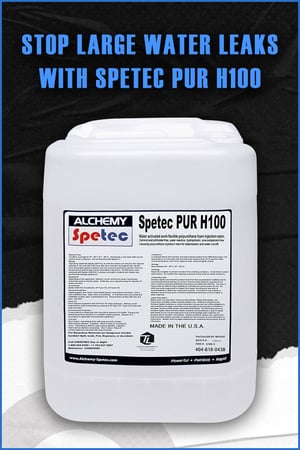 One of the greatest threats to our nation's infrastructure is unseen water eroding away its structural integrity. Water is relentless and all types of structures and sewer collection systems are at risk. If left unchecked, uncontrolled water will end up causing massive rehabilitation and repair bills. The market for repairing and controlling water infiltration is limitless.
 Translate