
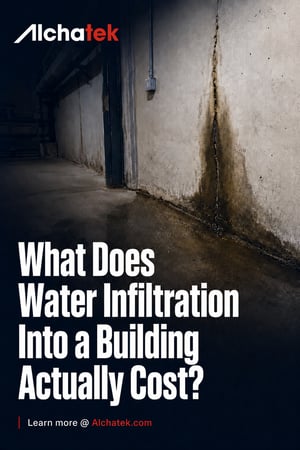
 For facility managers, property owners, and the contractors who serve them — what water getting into a building really costs, why surface fixes keep failing, and what it takes to stop it at the source.
Water infiltration into a building rarely announces itself with a dramatic failure. It shows up as a damp corner, a stain that returns after every storm, a musty smell in a lower level. That is exactly why the cost to fix water infiltration climbs the way it does. In the long run, leaks are relatively inexpensive to seal and very expensive to ignore. The water is not the whole problem. The path it found is.
What Water Infiltration Costs When It's Left Alone
The price of stopping water depends on how far it has been allowed to travel. A single active crack sealed early is a few hundred dollars. The same water, left to spread through finishes, flooring, and eventually the reinforcing steel inside the concrete, becomes a five-figure repair.
| Severity / Scope |
Typical Repair Cost |
Example Scope |
| Single active crack or joint |
$350–$1,500 per crack |
Interior polyurethane injection of one leaking wall crack or cold joint — no excavationg |
| Multiple cracks / full wall or floor area |
$2,300–$6,700 per project (≈$4,500 average) |
Several injected cracks or a wall or slab section in a basement, pit, or below-grade level |
| Water-damage cleanup once it spreads |
$3.50–$7.50 per sq ft |
Drying, demolition, and restoration of finishes, flooring, and contents — recurs with every event until the source is sealed |
| Severe / long-neglected |
$15,000+ |
Rebar corrosion and concrete spalling after years of infiltration; full structural removal-and-replacement runs $100–$250 per sq ft |
Source: ranges compiled from published 2025–2026 U.S. concrete-repair, crack-injection, and commercial water-damage restoration cost guides.
Industry-average ranges; actual costs vary by site, region, water condition, and severity.
The pattern in that table is the whole point. The cost does not rise gradually with the size of the crack. It jumps each time the water reaches something new — drywall, then flooring, then the steel that holds the structure together.
The Root Cause
Concrete is not waterproof. It is porous, and it cracks — from shrinkage as it cures, from settlement of the soil beneath it, from thermal movement, and from the steady hydrostatic pressure of groundwater pushing against any below-grade surface. Once a crack or joint connects one side of the structure to the other, water follows the easiest path it can find.
That path does not close on its own. Every wet-dry cycle widens it slightly. Pressure that was sealing a hairline opening one season forces it open the next. And because the visible symptom — the stain, the puddle — is several feet from where the water actually enters, owners often treat the symptom instead of the source. The wall gets painted. The floor gets patched. The water comes back.
The reason surface treatments keep failing is simple: they are applied to the negative side — the interior face the crew can reach — while the water pressure is on the positive side, the side the water is coming from. A coating on the negative side does not stop water that is being driven through the structure under pressure from the positive side. It only hides the entry point until the next storm.
Cost of Inaction vs. Cost of Repairing It Right
The cheapest repair is almost always the one done first. Here is how the three common paths compare over a five-year horizon.
| Approach |
Up-Front Cost |
What Happens Over 5 Years |
| Do nothing |
$0 now |
Repeated water-damage cleanup at $3.50–$7.50 per sq ft per event, mold remediation, lost finishes and inventory, square footage that cannot be leased or safely used, slip-and-fall liability exposure, and eventual structural repair |
| Surface patch / sealer (patch-and-repeat) |
Low per visit |
Negative-side coatings do not hold against positive-side pressure; the leak returns and the patch is redone on a recurring cycle |
| Polyurethane injection (fix it once) |
$350–$1,500 per crack |
Water-reactive resin fills the crack through the full depth of the structure and stays flexible; the leak is sealed at the source in a single visit, with no excavation |
For a commercial building owner, the cost does not stop at the repair bill. Water coming up through a floor or running down a wall makes that space impossible to lease and unsafe to occupy — every month it sits idle is rent not collected. Standing water and damp slabs are also a slip-and-fall hazard, and the liability from a single injury on the property can dwarf the cost of the repair that would have prevented it.
Patch-and-repeat looks like the budget option on any single invoice. Across a few years of repeat visits and the water damage that accumulates between them, it is the most expensive choice on the list.
Why Contractors Use Alchatek for This
Stopping water at the source means injecting a resin that does what surface products cannot: travel into the crack or joint, react with the very water that is leaking, and cure into a flexible seal that moves with the structure instead of cracking away from it.
Alchatek's leak-seal injection resins are built for exactly these conditions. The chemistry is matched to the water you are fighting — high-flow gushers, steady seepage, hairline weeps, or moving joints each call for a different product, and using the wrong one is the most common reason a leak comes back. Water-reactive polyurethanes expand and cure on contact with water, sealing the active leak from the inside without excavating the exterior, draining the structure, or shutting the building down. For applications in contact with drinking water, formulations certified for potable-water contact are available — confirm the specific certification on the product technical data sheet.
The positioning Alchatek brings to its contractors is the same one in this article: sell the customer the certainty of a leak that is gone, not a gallon of resin. A sealed structure that stays dry for years is a far easier sale than another patch.
Continue Reading
Stop the Leak at the Source
The cheapest water infiltration repair is the one you do before the water reaches anything else. Talk to an Alchatek specialist at (404) 618-0438, or find a trained contractor near you.
Cost ranges in this article are industry averages drawn from published 2025–2026 concrete-repair, crack-injection, and commercial water-damage restoration cost guides. Figures represent repair, not replacement, except where replacement is noted. Actual costs vary by site conditions, region, water condition, and severity.
Want more information on sealing leaks with polyurethane?



 A dam at the outflow of Lake Lulu in Winter Haven, FL is small in size but plays a large role for the Southern Chain of Lakes: flood control for surrounding communities, water level management for recreational use, and local water supply support.
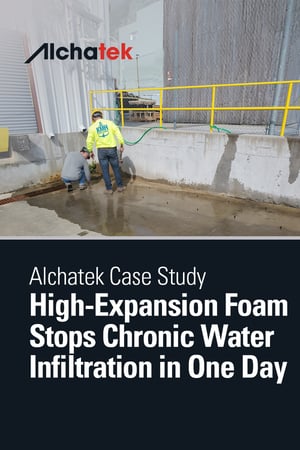 A below-grade warehouse loading ramp had water infiltration at the slab-to-wall cold joint. Hydrostatic pressure forced water and sandy soil through the joint during rainfall, clogging the French drain and requiring manual removal after each storm.





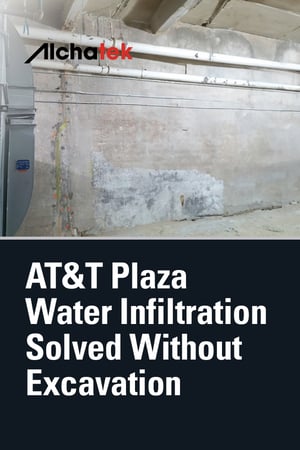 AT&T Plaza in downtown Dallas had persistent water infiltration issues in its basement and sub-basement levels, resulting in structural concerns and operational disruptions. The building's below-grade concrete walls developed multiple active leaks, allowing groundwater to penetrate the structure and causing dampness at wall-floor transitions, which raised concerns about potential corrosion of the reinforcing steel. Building management required an immediate solution that would effectively seal the leaks while minimizing disruption to commercial operations.
 A persistent water infiltration was observed in a below-grade tunnel in Houston, TX. Staining on the sheetrock ceiling indicated the leak originated at the joint between the tunnel shell and the building wall, specifically at the interface with the flashing. The tunnel was situated on the negative pressure side of the structure, resulting in recurring water intrusion issues. The property management team sought technical advice to resolve the leak without extensive demolition or disruption to the building’s operations.
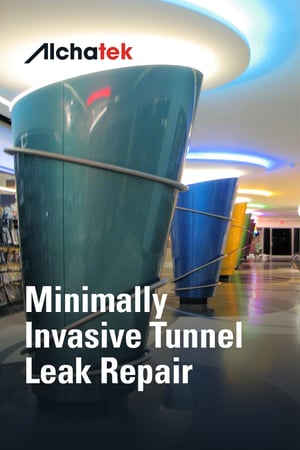 A critical downtown Houston pedestrian tunnel had persistent water infiltration affecting the ceiling, walls, and floor throughout the structure. The tunnel serves as vital underground infrastructure in Houston's urban core, where any significant disruption would impact pedestrian traffic and building access. Initial observations revealed widespread moisture intrusion, but the full extent of the problem remained unclear until interior finishes could be removed for proper assessment. The facility required a rapid, effective solution that would minimize downtime and restore the tunnel's watertight integrity.
 Translate