Looking for a Contractor?

Alchatek Blog

Seawall Repair: Flowable Fill vs Polyurethane Resin

Posted by J.R. Crowell on Dec 15, 2020, 10:00:00 AM

Banner-Seawall Repair Fill vs Resin

Body-Seawall Repair Flowable Fill vs Polyurethane ResinThis post is part of the Alchemy-Spetec Contractor Lens series, featuring views, news & case studies written by our customers.  This article, written by J.R. Crowell of Helms Polyfoam, explains the difference between two popular types of seawall repair materials.  If you're an Alchemy-Spetec customer and you'd like to discuss writing content for our blog, please send an email to marketing@alchemy-spetec.com today!.

Seawalls play an important role in shoreline protection and adjacent structure stability.  Over time however, hydrostatic pressure, storm surges, and simple aging will create the need for routine maintenance to be performed on the walls themselves as well as on the soil behind the walls.  When repairs are needed, it's important to use the most effective material available. 

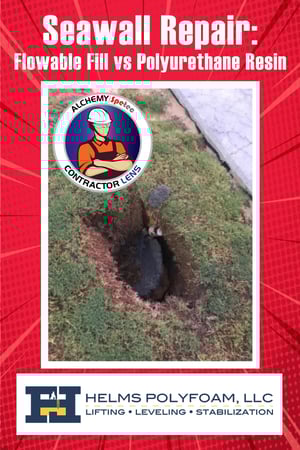
Let's take a look at a recent job in which two different materials were used.  We were brought in on a project where a metal coastal seawall was damaged by heavy erosion and washouts.  This particular repair was part of a larger scale revitalization to a public access area, so safety and aesthetics were very important.  Prior to our involvement, the repair plan to fill the voids called for flowable fill, a cementitious mixture, to be pumped into all known voids.  That process was completed on a Friday, and when the site was evaluated the following Monday, over half of the voids were back.  Why did this happen?  Here are a few reasons:

  • Flowable fill is a cementitious mixture with fluid properties.  Cement has a long cure time and it is heavy.  So, pumping this into a void caused by water infiltrating an already weak seawall means two things:

    • Water is present, so an even longer than normal cure time is expected. Longer cure time means more time for water to undermine the seawall.

    • Flowable fill relies on volume to fill voids.  More volume means more weight.  More weight on a weak/failing wall could make matters worse.

  • Part of sediment loss from behind the wall was due to larger, rusted holes. Based on the factors stated above, flowable fill will have a hard time setting up with water actively coming through the wall, which means you never get a complete seal on the holes.

  • Flowable fill doesn’t combine with soil, but rather fills up only large voids.  It is a thick material which means any small water paths will be hard, if not impossible, to reach.

The Solution:

We used a permeating, hydrophobic, polyurethane resin to seal off the problem areas.  This material is a bit of a hybrid chemical, meaning it has both permeating and expansive qualities.  (It should be noted that the expansive qualities are not synonymous with the qualities of the rigid, two part expanding foams used to lift and stabilize structures.)

Two days after the repair was completed, this area was hit with a tropical storm dumping 8” of rain in a matter of days and sending a powerful surge that caused waves to crash over the seawall. A thorough site evaluation the next week revealed that the polyurethane resin repair held.  So, why was this repair successful?

  • For starters, with active leaks and holes in a seawall, you want to stop the water inflow as fast as possible so that the material behind the wall can be strengthened.  Material used here has an expansion rate of 50x its liquid state and is moisture activated.  This combined with hydrophobic properties means that as soon as the resin touched moisture, it began to seek and force out all water in the area.  This is saying a lot when you take into account the material was also holding off pressure from coastal tides.

  • This resin has a very low viscosity (approximately 100cps) and is injected under pressure.  So anywhere water is going, it can go.  This is important because we are not just sealing the small holes, we are finding the small paths that flowable fill simply cannot get to.  There were instances where we had material reaction 10-15 ft from our injection point, meaning it found water traveling that far to cause problems.  Flowable fill can’t find that.

  • Remember we said this is a hybrid material and the permeation qualities are probably the most important part of this repair. Once the active leaks were sealed, the resin then permeated through the soil seeking out all large and hairline water paths.  As interaction with soil and moisture occurred, soil particles were combined and bound together to create a solid, water impermeable mass everywhere water once traveled.  Extra care was also taken to make sure the surrounding areas were treated to mitigate future erosion.  This was important because we were stabilizing the natural water paths, where water has been and will be trying to go, we weren’t just putting up a “dam”.  This method stops the water intrusion at its source and then strengthens the area.

Seawall failures are common and can be expensive and unsafe if done incorrectly.  We want to make sure you have access to all the information necessary to make an informed decision.  The initially failed repair was not at all due to negligence, but simply a lack of information.  The property owners weren’t aware of a better method.  Therein lies our mission, to solve problems permanently and educate while doing so.

Click here for more information on Helms Polyfoam.

Want more information on seawall repair with polyurethane?

Download an Info-Packed Seawall Repair Brochure!

Topics: Repair Seawalls, All Posts

John Ziebell Reflects on 36 Years in the Industry

Posted by Kreg Thornley on Nov 19, 2020, 10:00:00 AM

Banner - John Ziebell Reflects on 36 Years in the Industry

Body - John Ziebell Reflects on 36 Years in the IndustryOn this episode of The Injection Connection, Charlie Lerman takes over the hosting duties, welcoming Alchemy-Spetec independent rep John Ziebell. Formerly the Vice President of Operations for Deneef Construction Chemicals, Inc., John has 36 years of experience in the chemical grout industry and is currently a member of the International Concrete Repair Institute (ICRI).

Listen to the episode in its entirety below, or check it out on TheInjectionConnection.com and the following platforms:

Want info on Alchemy-Spetec products?

Download the Info-Packed Leak Seal Product Catalog!

Download the Info-Packed Geotech Product Catalog!

Topics: Repair Seawalls, Equipment & Accessories, All Posts, Lift Slabs, Seal Leaks, Stabilize Soil, Business Tips

PolyShark Seawall Repair & Soil Stabilization Pump Skid

Posted by Colt Hullander on Nov 10, 2020, 10:00:00 AM

Banner-PolyShark Seawall Repair & Soil Stabilization Pump Skid

Body-PolyShark Seawall Repair & Soil Stabilization Pump Skid GraphicSingle-Component Geotech Pump Skid

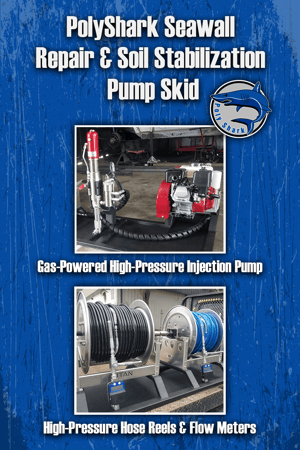
The PolyShark is a custom pump skid system for installation of single-component polyurethane geotech resins. This world-class skid set up is essential for large scale seawall repair, soil stabilization, and void fill projects.

The PolyShark includes a gas-powered high-pressure injection pump, two hose reels, and flow meters.

Gas-Powered High-Pressure Injection Pump

A step up for projects that require greater power and output, this custom modified pump is our best-selling gas over hydraulic piston machine, favored by contractors who want to complete large application jobs in record time with high profit margins. The hydraulic ram fluid section is moved front and center in the configuration for easier maintenance and control.

High-Pressure Hose Reels with Stainless Steel Ball Bearings

High-pressure design guarantees durability when used with the high-pressure single-component pump. The construction is completely corrosion resistant and the stainless steel ball bearings, hardware, and manifolds are stronger than the aluminum parts on standard hose reels. The ball bearing-driven hose reels operate smoothly because they contain no bushings. (Bushings easily wear out.)

Flow Meters

Two high-pressure flow meters are capable of recording the exact amount of product pushed through the hoselines. This allows for precision material-use tracking.

Want more information on this seawall repair/soil stabillization skid?

Download an Info-Packed PolyShark System Brochure!

Topics: Repair Seawalls, All Posts, Stabilize Soil

Field Service When YOU Need It

Posted by Charlie "The Grout Geek" Lerman on Oct 27, 2020, 10:00:00 AM

Banner - Field Service When YOU Need It

Body - Field Service When YOU Need ItWe understand that chemical grouting is often not the primary focus of a construction or repair job, but a water leak can often bring the rest of the job to a screeching halt until it is sealed. Job costs then start to pile up, production or facility services stay shut down as time drags on, sometimes tempers begin to flare. Sound familiar?

It’s not an exaggeration to state that Alchemy-Spetec has the most experienced and responsive technical support squad in the industry. In the spirit of the famous postal service motto, “Neither snow nor rain nor heat nor gloom of night stays these couriers from the swift completion of their appointed rounds”, our approach is somewhat along the lines of, “Neither weekends nor evening hours nor holidays…”. In other words we strive, to the best of our ability, to be there for you when YOU need us.

For example, Alchemy-Spetec has provided technical support for critical infrastructure jobs over Thanksgiving, Christmas and New Year’s Day. While on-site technical service response is based on availability and job circumstances, we have a track record of being there when it counts. In the chemical grouting industry, almost all other manufacturers have moved away from dedicated fulltime support personnel. We stand alone to help you when YOU need it.

Want more information on Alchemy-Spetec products?

Download the Info-Packed Geotech Product Catalog!

Download the Info-Packed Leak Seal Product Catalog!

Topics: Repair Seawalls, Equipment & Accessories, All Posts, Lift Slabs, Seal Leaks, Stabilize Soil, Business Tips, Deep Lift

Polyurethane Seawall Repair in Florida

Posted by Andy Powell on Aug 27, 2020, 10:00:00 AM

Banner - AS - Polyurethane Seawall Repair in Florida

Body - AS - Polyurethane Seawall Repair in FloridaWith 1,350 miles of coastline, Florida is home to countless seawalls.  If you're a property owner or manager in the Sunshine State, you have landed in the right place. Alchemy-Spetec provides environmentally safe seawall repair polyurethane materials to contractors covering all of Florida. (These seawall repair foams are NSF approved for contact with potable water.) If you have a seawall requiring evaluation, we'd be happy to refer you to an experienced contractor covering your area. Call us now at 404-618-0438.

If you're still in research mode, we have plenty of information for you on this website about polyurethane seawall repair. Visit the Seawall Repair Overview Page for a brief explanatory video, product info and a complete list of seawall repair blog articles at the bottom.

In a previous blog post, Polyurethane Seawall Repair Explained, we reviewed the benefits of repairing with polyurethane...

Why Use Polyurethane for Seawall Repair?

Non-Intrusive Application
Polyurethane can be injected through pipes directly into voids and loose sandy soil using small portable equipment.

Proven Solution
Seawall repair resins are used extensively seal cracks, voids and defects as well as for filling voids and stabilizing the soil.

Creates an Impermeable Mass
Polyurethane seals leaks along the wall, fills the voids that have occurred, and mixes with the soil to form a solid, impermeable mass.

What Are the Results of Polyurethane Seawall Repair?

Long Lasting Solution
Alchemy-Spetec seawall repair resins cure to a strength greater than crystalline bedrock. Combined with proper drainage, this method can greatly extend the life of your seawall.

Water Tight Seawall
The resin reacts with water or moisture in the soil and expands to fill voids while it permeates sandy soil to form a solid, strong, watertight mass.

Click here to read the rest of Polyurethane Seawall Repair Explained.

Property owners and managers in Florida can rest assured.  If you have seawall problems, we have you covered.  Contact us at 404-618-0438 for a referral to a contractor near you.  

Want more information on seawall repair with polyurethane?

Download an Info-Packed Seawall Repair Brochure!

Topics: Repair Seawalls, All Posts

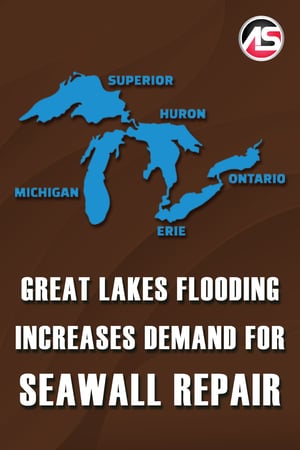
Great Lakes Flooding Increases Demand for Seawall Repair

Posted by Erik Prinzing on Aug 20, 2020, 10:00:00 AM

Banner - Great Lakes Flooding Increases Demand for Seawall Repair

Body - Great Lakes Flooding Increases Demand for Seawall Repair

According to the Detroit Free Press, rising water levels on the Great Lakes have hit records in 2020, leading to extensive flooding and unusually aggressive shoreline erosion. Many property owners and contractors in the area are now researching seawall repair methods. This type of research typically reveals three options: the common methods of excavation or repair with cement grout, and the next generation method of repair with high-strength polyurethane.

Common Seawall Repair Options

In a previous blog post, An In-Depth Look at Polyurethane Seawall Repair, Andy Powell explained two of the most common options, along with their drawbacks...

Seawall Excavation

You can tear out the wall (or part of the wall) and replace it. This approach has a few daunting downsides. Namely, it can be…

  • Costly
  • Time consuming
  • Environmentally damaging
  • Requires time consuming permits

Paying for a new seawall is no doubt going to cost more than any kind of repair. A complete rebuild will also take some time. Not to mention the inevitable mess, a good portion of which is likely to end up in the water. Excavation also requires getting a permit, which can eat up a LOT of time. 

Seawall Repair with Cement Grout

We still see contractors and property owners filling sinkholes and trying to plug seawall leaks concrete. This outdated approach has many disadvantages when compared to polyurethane repair. For example, it’s…

  • Product, labor and machinery intensive
  • Time consuming
  • Prone to degradation
  • Heavy (adds weight to seawall or bulkhead already under stress)

The amount of cement grout, labor and machinery required can be quite disruptive as well.  Compared to the stealth, surgical approach of polyurethane repair, the property owner can end up with quite a mess on their property during a cement grout repair job. Needless to say, with all this extra material, machinery and labor – the whole process takes longer than your typical polyurethane repair. Cement grout is known to shrink and degrade over time as well. Imagine the frustration of paying for an expensive seawall repair, only to see it wash out over the next few weeks. Cement that doesn’t wash out can add weight to the structure and sink over time.

Click here to read the rest of Andy Powell's blog post - An In-Depth Look at Polyurethane Seawall Repair.

Next Generation Seawall Repair with Polyurethane

Polyurethane repair material addresses the primary weaknesses inherent in excavation and repair with cement grout. This includes minimal disruption from equipment, labor, and messy materials; plus a quick return-to-use time. Alchemy-Spetec offers high-strenth polyurethane foams for repairing seawall cracks, voids, and surrouding soil.  Alchemy-Spetec seawall repair foams are also NSF-approved for contact with potable water.

Want more info on polyurethane seawall repair?

Download an Info-Packed Seawall Repair Brochure!

Topics: Repair Seawalls, All Posts

Three Critical Warning Signs of Possible Seawall Failure

Posted by Erik Prinzing on Jul 28, 2020, 10:00:00 AM

Banner - Three Critical Warning Signs of Possible Seawall Failure

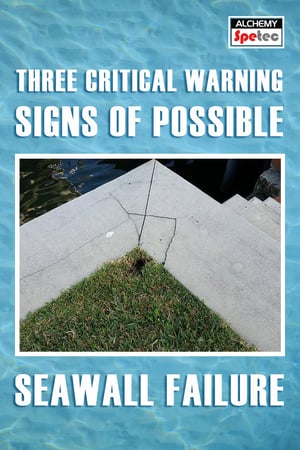
Body - Three Critical Warning Signs of Possible Seawall FailureStorms, tidal action, and soil erosion constantly cause damage to seawalls. It is essential to identify any problems as early as possible. Here are the most common warning signs of seawall failure:


Blocked Weep Holes

Weep holes function as a pressure-relief valve that allow for drainage of any water that gets behind a seawall. They are visible from the water side, just above the surface usually. A clogged or blocked weep hole could spell trouble. If you find debris in the weep holes, act immediately to prevent water pressure from building up and damaging the seawall.

Voids and/or Sinkholes Near the Inside Edge

In many cases, too much water leaks through to the inside of the seawall. Voids and sinkholes then appear on the land side of the wall due to a loss of soil underneath. Removing the grass near the edges of the seawall to expose possible holes is good practice.

Expanding Concrete Cracks

Damage to concrete in a seawall can expose the interior steel rebar to water. Over time, the rebar (which structurally supports the concrete) can begin to rust and stain the surrounding areas. The added rust causes the rebar to expand, and cracks in the concrete begin to grow.

Polyurethane Seawall Repair

Many seawall issues can be resolved or even prevented with polyurethane seawall repair. Polyurethane can be injected through pipes directly into voids and loose sandy soil using small portable equipment. Polyurethane seals leaks along the wall, fills the voids that have occurred, and mixes with the soil to form a solid, impermeable mass.

Want more information on polyurethane seawall repair?

Download an Info-Packed Seawall Repair Brochure!

Topics: Repair Seawalls, All Posts

Common Causes of Seawall Failure

Posted by Erik Prinzing on Jul 16, 2020, 10:00:00 AM

Banner - Common Causes of Seawall Failure

Body - Common Causes of Seawall FailureSeawalls are built to create a strong and stable barrier between a body of water and adjacent land, but why do they fail over time? Here are three common factors that can damage a seawall.


Soil Erosion

Incoming tide water pushes against a seawall and through cracks, joints, and defects. Over time soil erosion can occur on the inside of the wall. When the tide falls, water flows out and this erodes the soil, thereby weakening the structure. Soil erosion will begin to form small sinkholes in the corners of the inside section of a seawall. During periods of heavy rainfall, this problem worsens, and the deterioration process speeds up. Sinkholes are one of the earliest signs of trouble for a seawall.

Clogged Vents and Weep Holes

Constructing vents and weep holes in the seawall to allow the water behind it to drain and pass through is good practice in order to prevent pressure build-up. Unfortunately, when debris forms and blocks these holes, the channel for water passage seizes to exist. This can then cause the pressure build-up to occur. After some time, the pressure can crack the seawall and the water may find other flow passages causing unwanted soil erosion. 

Natural Disasters

If you live in an area that is susceptible to hurricanes, a seawall will very likely take some damage during hurricane season. The powerful winds erode soil from the back of the seawall to create sinkholes and voids. A lot of this damage can be prevented by reinforcing a seawall for the hurricane season.

Polyurethane Seawall Repair

You can greatly extend the life of a seawall by reinforcing or repairing it with semi-rigid hydrophobic polyurethane foams that react with moisture in the soil and expand to fill voids while they permeate sandy soil to form a solid, strong, watertight mass.

Want more information on Seawall Repair?

Download an Info-Packed Seawall Repair Brochure!

Topics: Repair Seawalls, All Posts

Colt Hullander Joins Alchemy-Spetec as Director of Technical Services - Geotech Division

Posted by Kreg Thornley on Jul 14, 2020, 10:00:00 AM

Banner-Colt Hullander Alchemy-Spetec

Body-Colt Hullander Alchemy-SpetecAlchemy-Spetec is pleased welcome Colt Hullander! Colt will join us as the new Director of Technical Services – Geotech Division, supporting Alchemy-Spetec customers on a wide variety of polyurethane jobs, from slab lifting to soil stabilization and seawall repair. He brings a decade of geotech experience to the team.

Colt put in many years as a project manager for Stable Soils of Florida where he oversaw polyurethane rig assembly and chemical grout installation projects. After that he briefly worked for Alchemy-Spetec as a Tech Services Rep for about a year. Colt then amicably moved on to Ramjack South Florida to become a Project Manager for their Seawall Division. We are happy to welcome him back in this new role.

Alchemy-Spetec VP of Sales & Business Development Jim Spiegel is excited about the ways in which this hire will benefit the market: “Colt brings many years of invaluable field experience with expertise in a wide range of equipment, products, and techniques. His field experience coupled with his technical acumen for equipment improvements will undoubtedly offer our Geotech customers another industry-leading resource. As most grouting contractors agree, there is no substitute for field experience, and Colt has no shortage of it.”

Want more info on Alchemy-Spetec products?

Download the Info-Packed Geotech Product Catalog!

Download the Info-Packed Leak Seal Product Catalog!

Topics: Repair Seawalls, All Posts, Lift Slabs, Stabilize Soil, Deep Lift

The Design of Coastal Revetments, Seawalls, and Bulkheads

Posted by Charlie "The Grout Geek" Lerman on Jun 11, 2020, 9:48:34 AM

Banner-Design of Seawalls

Body-Design of SeawallsChemical grouts have an amazingly diverse range of properties. This makes them incredibly useful for all types of waterproofing, soil modification, and structural repairs. This wide range of characteristics means that there is no one size fits all grout out there. But I get ahead of myself. Before one can select a chemical grout for a repair it is necessary to understand not only the asset to be repaired but also how and why it is failing and/or leaking. There are numerous methodologies that can be utilized to determine what is going on, but before one can start the troubleshooting one needs to understand the structure's design.

This is why I love articles like this one from PileBuck.com. It gives a good overview of seawalls and bulkheads. These structures are often the frontline in our war against erosion and thus require periodic maintenance. We at Alchemy-Spetec are committed to providing cost-effective, high-quality grouts tailored to the precise needs of the project. We know that a quality grout is just the beginning and we follow-through with the most experienced technical support in the industry. Enjoy the article...

Along bluffs and coastal shorelines, various structures are often necessary to protect beaches from wave action, or to retain fill or in situ soil.  There are three primary structure types that can be utilized to accomplish these goals, including protective materials laid on slopes, known as revetments, and vertical structures, which are classified as either seawalls or bulkheads.

Revetments are typically constructed of stone or other durable materials to provide protection for designated slopes.  They are built with an armor layer, a filter layer or layers, and toe protection.  The armor layer can consist of interlocking structural elements designed to form a geometric pattern, or a random mass or stone or concrete rubble.  Next, a filter layer will ensure drainage and protection of the underlying soil.  Finally, toe protection will offer stability against undermining at the base of the revetment.

While bulkheads and seawalls are both types of vertical structures used to protect coasts, they have different purposes.  Bulkheads are used to retain or prevent the sliding of land, with protection of the upland area from wave action as a secondary consideration.  In contrast, the primary purpose of seawalls is to intercept waves.  Bulkheads can be cantilevered, anchored, or gravity structures, with their use limited to areas where wave action can be resisted by the types of materials used in these respective designs (such as sheet piling or rock-filled timber cribs).  For areas where intense wave action exists, massive concrete seawalls are the more appropriate choice, with either a vertical, concave, or stepped seaward face.

Read the rest at PileBuck.com...

Want more info Alchemy-Spetec products?

Download the Info-Packed Leak Seal Product Catalog!

Download the Info-Packed Geotech Product Catalog!

Topics: Repair Seawalls, Seal Leaks