Looking for a Contractor?

Alchatek Blog

Crack Injection and Curtain Wall Grouting - Part 3

Posted by Charlie "The Grout Geek" Lerman on Mar 17, 2017 11:47:05 AM

What is Curtain Wall Grouting and Why is it Effective?

Curtain wall injection is the process of drilling holes through a structure in a diamond pattern, then injecting the grout into soil on the other side. This procedure creates a curtain wall made of a resin/soil mixture that prevents water from getting back into the structure. It is often required if there are multiple cracks or leaks in a wall. Filling each individual crack may cause you to waste time following the water from crack to crack. Curtain wall grouting allows you to stop multiple leaks at one time and protects the structure on a long term basis.

This procedure was first performed in 1960 on a sewer manhole with a multiple leak problem. As described above, chemical grout was injected through to the outside of the manhole. This created a “positive side seal” (on the side the water is coming from), blocking water from penetrating the joints of the structure.

This method is still used today and is the most effective method for grouting manholes to stop infiltration.  It is effective on structures constructed from a wide variety of materials, including wood, steel, concrete, rubble walls, stone, block and brick.part-1-1.png

A Brief Overview of the Curtain Wall Grouting Process

  • Injection holes are drilled in a diamond grid pattern (see photo included with this blog post).
  • Grout injection begins at the bottom of the wall.
  • Grout is then injected a little higher, so that any excess grouts flows down over the previous injection area.  This creates a lapping effect, like shingles on a roof.
  • Injection continues to the top of the wall.


Other Situations Requiring Curtain Wall Grouting

In addition to the “too many leaks” scenario, curtain wall grouting may be required when all cracks cannot be identified in a leaking wall, when previous crack injection has failed, or when a structure has a negative crack injection history. It is also used in masonry, dealing with stone and CMU walls that do not crack inject well.

Material selection is based on various factors such as soils, voids, and moisture conditions. Call us at 404-618-0438 to discuss which material is right for your project.

Want to learn more about this procedure?

Download an Info-Packed Curtain Wall Grouting Brochure!

Topics: All Posts, Seal Leaks

Crack Injection and Curtain Wall Grouting - Part 2

Posted by Charlie "The Grout Geek" Lerman on Mar 15, 2017 11:41:14 AM

Crack Injection

Crack injection has many advantages over other methods.  For example, if you’re sealing a leak in a water tank, you can inject from the outside of the tank. So the tank can remain in service while you repair it. Having to dry a crack, like you do with epoxy resin, is not needed as this material reacts with water. The material also remains flexible at all times.

Steps to (1).pngCrack injections can be applied in both vertical cracks and in horizontal cracks. With vertical cracks, it is imperative to start at the bottom of the crack and work your way up the crack until it is filled. This forces the material up and through the crack and will simultaneously push the water up and out as well. With horizontal cracks, injection can be started at either the left or right end.

The crack injection process is rather simple, but some mis-steps can prove quite costly. For best results, follow the steps below after discussing them in detail with a trained professional...

Step 1. Identify crack locations.

Step 6. Insert injection ports on both sides of crack.

Step 2. Estimate the amount of resin you’ll need. (One gallon per 25 linear feet of cracks.)

Step 7. Inject water into each port.

Step 3. Prepare surface of crack.

Step 8. Start injection of material.

Step 4. Drill injection holes at a 45 degree angle.

Step 9. Always grout twice

Step 5. Flush out all injection holes with water. 

Step 10. Add water again


A Few Words on Acrylate Grouts

Customers who joined us in the Alchemy Polymers era may not be familiar with the acrylate grouts we’re now offering after the merger with with Resiplast US.  Acrylates offer a very wide range of set time control, which makes them good for everything from very tight cracks to gushing leaks (not to mention soil stabilization). One thing to be aware of: all wetted metal equipment parts that acrylates come into contact with must be stainless steel.

Crack Injection Products

If you’re not completely familiar with all or our products, talk to a tech support rep to determine which one is the best for your project. Alchemy-Spetec offers the following crack injection solutions…

Acrylates

AG100, AG200 and AG300

Polyurethanes

PU F400, PU F1000 and AP Seal 500

Want more information on leak seal technologies?

Download an Info-Packed Leak Seal Brochure!

Topics: All Posts, Seal Leaks

Crack Injection and Curtain Wall Grouting - Part 1

Posted by Charlie "The Grout Geek" Lerman on Mar 13, 2017 2:00:00 PM

Part-1.pngWhat are Chemical Grouts?

Chemical grouts are water reacted or chemically reacted materials that are designed to shut down active water leaks, stabilize soils and lift slabs in various structures.

Some of these materials are formulated to stop high volume leaks (2000 gpm) or used to stop small leaks in water and waste water treatment tanks.

Geotechnical applications include but are not limited to:

Soil Stabilization, Railroad Ballast Rock Stabilization, Tunnels, Mines, and Seawall Repairs

Why Chemical Grouts?

Chemical grouting serves as the most efficient permanent repair procedure.  It also features little disruption to the local communities as repair times are not extensive. As you all know, leak repairs must be preformed prior to coatings. But why is chemical grouting important? Grouting is the only permanent repair procedure that seals leaks from the positive side (where the water’s coming from) and fills voids in record times.

Hydrophilic & Hydrophobic

It is crucial to understand the basic differences in hydrophilic, hydrophobic, and multiple component chemical grouts. Choosing the correct repair materials for a job is very important.  Let’s dive into the specifics to gather a deeper understanding of the different types of polyurethane grouts.

Hydrophilic

Hydrophilic grouts injected in a confined space shrink more but create a better bond with the substrate. Hydrophilic chemical grouts are resilient and flexible after full cure and allow movement within structures without causing damage to the seal or bond.

Alchemy-Spetec Product Examples: AP Seal 500, PU GT350

• No catalyst needed

• Great bond

• Flexible

Absorbs water

• Needs water to react

• Medium to high shrinkage

• Resin only

• Medium expansion         

• Needs to be subjected to water

• Foam or gel

Hydrophobic

Hydrophobic grouts injected in a confined space have very little shrinkage, but depend much more on expansion to create their bond with the substrate. Hydrophobic chemical grout has a low viscosity characteristic that permeates loose and non-consolidated soils readily and effectively.

Alchemy-Spetec Product Examples: AP Fill 700, PU F400, PU H100

• Uses a catalyst

• Repels water

• Grout will not shrink

• Low shrinkage

• Needs water to react

• High expansion

• Rigid and flexible

• Adjustable set times

• Resin + catalyst

• Foam

Multi Component

Multi-component closed cell foam maintains its physical form and is not subject to shrinkage due to wet/dry cycles. It is a rapid curing; self-leveling concrete repair material perfect when minimal down time is required.

Alchemy-Spetec Product Example: AP Lift 475

• Rigid

• High density

• Flexible

• High compressive

• High expansion

• Strength

• Rapid set times

• Closed cell

Cured polyurethane is harmless for the environment and resistant to biological attacks.

Want more informoation on leak seal grouts?

Download an Info-Packed Leak Seal Brochure!

Topics: All Posts, Seal Leaks

Polyurethane Slab Leveling Allows Omaha Warehouse to be Repurposed

Posted by Andy Powell on Mar 10, 2017 11:55:45 AM

Polyurethane Slab Leveling Allows Omaha Warehouse to be Repurposed as Office Space (1).png

Sometimes lifting concrete slabs with polyurethane is about more than just making something structurally sound and level again.  In every town there are buildings sitting empty because the floors are not in sufficient shape for use by a business.   Imagine the service a concrete leveling contractor can provide by bringing slabs back into tolerance and allowing an empty space to become a revenue stream for the building owner.  This is what our contractor in Omaha Nebraska,The Rite Touch, did recently.

In downtown Omaha there are a lot of historic buildings.  Located on the site of the old stockyards, there is a building constructed in 1911 that had been used as a parts depot for many years; including parts for World War II era Jeeps.  Some of those are still there.  The owners of the building have converted some of it into a commercial laundry equipment distribution facility, but there was a section with sagging floors that really couldn’t be used effectively.

Some research on the internet led them to our customer in Omaha, The Rite Touch.  They have been doing concrete lifting and leveling for a few years now (in addition to spray foam and polyurea flooring systems).  This particular lift was a little tricky because the concrete literally had a belly, or sag, down the center.  The owner’s idea was to create an office space with partitions / cubicles for small businesses.  However, the current floor condition would have everyone’s office chair rolling to the center of the building.   Not good!  How would the floor react as they tried to bring it up a couple of inches?  I was onsite as a consultant to help them find out!

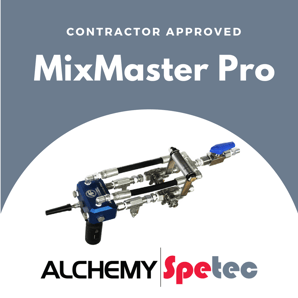
We gave ourselves a reward to shoot for if the lift was successful; a big slab of Omaha prime rib.  With that as a motivation we got to work slowly working our way across the floor and back.  Using zip levels, dial indicators, and instinct developed from other jobs, we slowly brought the old floor back into tolerance.  The product we selected for this project was AP Lift 430 and it worked beautifully.  The new MixMaster Pro injection gun performed as advertised and allowed for an efficient installation of the poly foam.  Although we had to drill multiple holes for the targeted injections, we only used three total injection ports.

Now the final touches are being added to this soon-to-be office space.  The owners will have multiple tenants paying rent and a once unusable space as a revenue generating property.  If you’re a property owner with a similar issue, call us to get hooked up with a contractor who can help.  If you’re a contractor, keep your eyes peeled for similar opportunities.  They are all over the place.  Now, about that prime rib….

Want more info on polyurethane slab lifting?

Download an Info-Packed Slab Lift Brochure!

Topics: All Posts, Lift Slabs

Seeking Independent Manufacturing Representative

Posted by Stephen C. Barton on Mar 8, 2017 12:22:15 PM

6.pngManufacturing Representative (Metro DC area, Virginia, Maryland)

Do You Know Someone Who Would Be Perfect for This Position?

Alchemy-Spetec is seeking a talented experienced Manufacturing Rep to join our high growth team. The company is based in Tucker, GA.  The Manufacturing Rep territory is in the Metro DC area, Virginia and Maryland.
 
We are looking for a rep who has experience in the waterproofing industry.  This rep will have to possess the ability to find contractors and develop them to use our products.
 
This rep will travel in the three states calling on municipalities, specifying engineers, architects, geotechnical engineers, soil contractors, grouting contractors and waterproofing contractors that may have interest in our products.
 
This is a great product line for a rep that is already selling waterproofing products.  Manufacturing Rep can not have a competing product line with any of our products.

Apply online by following this link:  Alchemy-Spetec Manufacturing Representative Application

Please note, this is an independent contractor position; the selected candidate will not be an employee of Alchemy-Spetec.

Alchemy-Spetec is an equal opportunity employer.

Topics: All Posts

Help Wanted - Southeastern Regional Sales Manager (Florida)

Posted by Stephen C. Barton on Mar 6, 2017 1:57:22 PM

Help Wanted.pngSoutheastern Regional Sales Manager (Florida)

Do You Know Someone Who Would Be Perfect for This Position?

Alchemy-Spetec is seeking a talented, results driven Southeastern Regional Sales Manager with an entrepreneurial spirit to join our high-growth organization. Although our office is located in Tucker GA, the position will be based in Florida.

We are a well established company looking to hire a sales superhero. 

Job Requirements

  • Travel in-state (meetings with prospects, specifying engineers and contractor customers) and nationally (trade-shows 1-3 times per year) required
  • Excellent communication skills – written, oral, and interpersonal (including public speaking to varied audiences)
  • Ability to build and maintain highly effective internal and external relationships
  • Demonstrated ability to work independently and self-directed

Major Job Responsibilities

  • Find contractors and develop them to become high value customers.
  • Find new specifying engineers to write specifications around our product.
  • Find projects for contractor customers to perform with our products.
  • Enter all contacts, history, opportunities, and follow-ups into CRM database.

Apply online by following this link:  Alchemy-Spetec Southeastern Regional Sales Manager Application

Alchemy-Spetec is an equal opportunity employer.

Topics: All Posts

Welcome Alchemy-Spetec Regional Managers

Posted by Stephen C. Barton on Mar 3, 2017 1:34:32 PM


WELCOME-1.pngPlease join us in welcoming Anthony Sandone and Thad Brown to the Alchemy-Spetec team. They have joined the newly merged company to further develop our growing portfolio of regional and national accounts.

Anthony Sandone comes to Alchemy-Spetec with 21 years of experience in the construction technologies field. Most recently, Sandone worked as the East Coast Regional Manager (ECRM), for ResiPlast. There, he effectively led outreach efforts that included presentations, training seminars, and marketing material creation to train potential clients and secure accounts. This background will help Sandone make an easy transition into the current position of East Coast Regional Manager for Alchemy-Spetec. Sandone also joins our Tucker office remotely by way of Pennsylvania.  In his spare time, Anthony is an avid sports fanatic with his children being heavily involved in basketball and soccer.

Thad Brown comes with a wealth of experience in the industry, having spent the last 27 years at Sika Corporation. At Sika, Thad was instrumental in acquiring numerous large accounts. Brown joins Alchemy-Spetec as the West Coast Regional Manager (WCRM). Brown's wealth of industry knowledge from his 39+ year career will make him a great addition to the team. Brown remotely joins our Tucker office by way of California. In his spare time, Thad is a current member of the Washington Glass Association (WGA) and has for the past 30 years participated in the association’s annual golf tournaments.

We view these placements as a sign of our dedication and commitment to our customers.

Have any questions for Anthony or Thad?

Sign Up for a Consultation Now!

Topics: All Posts

Transitioning to the Alchemy-Spetec Brand

Posted by Stephen C. Barton on Feb 27, 2017 2:07:33 PM

Alchemy-Spetec-Logo - Web-Res.png


As I mentioned in this recent blog post, Alchemy Polymers and ResiplastUS have joined forces to become Alchemy-Spetec. We think you'll find this a positive development, as ResiplastUS has been widely known for their extensive line of polyurethane and acrylic leak seal/water stop products.

Have any further questions about the merger?

Sign Up for a Consultation Now!

Topics: All Posts

Re-Engaging Past Customers

Posted by Andy Powell on Feb 24, 2017 1:30:00 PM

So you’re a contractor with an amazing business model and have superior results under your belt. Whether your focus is in soil stabilization, leak seal, or slab lifting, it’s a known fact that growing your contracting business is hard work. As a technical consultant, I am aware that many contractors focus so much time on generating new leads that they may overlook another great source of new revenue: re-engaging past customers.

In case you didn’t know, it costs about 5 times more money to attract a new customer than to sell to an existing customer. I’m speaking to your pockets aren’t I? And it's 50% easier to sell to an existing customer than to a new customer. It has also been said that 80% of most business revenue comes from just 20% of its existing customers. (Source: Forbes Magazine's "Five Customer Retention Tips for Entrepreneurs".)

Re-Engaging past Ciustomers.pngHere's a list of customer types who are likely to provide repeat business...

  • Large scale commercial property owners
  • Large scale residential owners
  • Chain stores
  • City education department's/districts
  • Municipalities/govt agencies

If you put your mind to it, I'm sure you can think of a few more. You can also reach out to individual residental and small business customers ocassionally.

Customer Retention Tips

Remember, customers do not owe you their loyalty, it has to be earned. You may be the most qualified and diversified contractor in the area, but if you want to get that repeat business you have to implement a retention program. Here are a few suggestions...

Create an email newsletter. Send out tips and advice that your customer base may find helpful. You can also include case studies or success stories from recent jobs. Holiday greetings are always good as well. Throw in a promotion or discounted service offer every now and then, but make sure your communications are always primarily focused on useful content.

Gifts, holiday cards and birthday cards are a nice way to express customer appreciation. Mailing them items like this will help you stand out from the crowd a bit, as more and more people are moving towards a "digital only" approach.

Take a moment on a regular basis to check up on your past customers' social media accounts. Like, favorite and share anything you find relevant or interesting. This is just another way to remind them that you're interested in how they're doing and that you're available, should they need any further assistance.

Anyways, you get the idea. Take some time to brainstorm and I bet you'll come up with some unique approaches of your own. If you're too busy to do this kind of stuff, hire a part-time assistant. The jobs you get as a result of these activities may pay for the assistant, and then some. Give it a shot and find out.

Want more advice on re-engaing past customers?

Sign Up for a Consultation Now!

Topics: Business Tips

Contractor’s Guide to Creating a LinkedIn Company Page

Posted by Diamond Purvis on Feb 20, 2017 11:30:00 AM

In the previous post, I discussed creating an effective personal LinkedIn profile for contractors. In this post, I'll discuss creating a contractor company page on LinkedIn. (Please note that you have to create a personal profile on LinkedIn before you create a company page)

LinkedIn company pages help to build brand awareness by promoting your business and services to customers and industry professionals.

Creating the Page
3.png

  1. While logged into your personal LinkedIn profile, move your pointer over Interests at the top of your home screen and select Companies
  2. Click Create in the Create a Company Page box on the right side of the screen.
  3. Enter your company's official name and your email address.
  4. Click Continue and then proceed to enter your company information.
    • This is the space to complete an overview and detailed description of your company. Mention key services and include a few points about what makes your company unique.
    • Be sure to keep your description concise and use words that your customers may search for.

Insert a Logo and Banner

A LinkedIn company page is essentially an extension of your brand. A banner and logo will bring your page to life. It also shows on employee profiles. (Be sure to have any employees add the company page on their personal profiles for greater reach.)

Next, you want to create an attention grabbing banner to feature a key message. Next, create an eye-catching background image and feature key messaging on your page.

Company Updates

Updates are basically what you share with your connections (similar to a "post" on Facebook).

Posting tailored content consistently is the most effective way to engage your target audience.

Your main objective is to engage rather than to simply advertise. Share thought leadership pieces, advice and helpful tips related to your contracting niche, etc. Include media such as videos, presentations, images, and even info graphics to keep things exciting. Your goal is to help your target audience instead of simply making sales pitches.

LinkedIn’s activity level is not the same as other more active social platforms. Don’t overload your followers’ feeds with constant updates. Stick to one post per day or three per week. The best times to post are early in the morning or late in the workday.

Showcase Pages

LinkedIn showcase pages are essentially an extension of your company page and can be used to highlight and differentiate services. This allows users to follow certain pages for specific topics or services of interest. More relevant content in their news feeds leads to higher engagement rates.

Promotion and Engagement

Your employees are your biggest advocates and also the best place to start building up your company page followers. Encourage your employees to create LinkedIn profiles and add the company. They will start receiving company updates to like, share and comment on, which in turn extends your reach.

Promote your company page by linking it to your emails, newsletters, and blogs. Add a button to your website to make it easy for visitors to click and follow. Send an email to existing contacts and encourage them to follow your company page. Use your other social channels to cross-promote your page such as FaceBook, Twitter, and YouTube.

Conclusion

Many contractors are not using company pages to their full extent. Unlike FaceBook, this channel isn’t crowded yet. LinkedIn company pages are slated to grow significantly, and if your target audience is there you must create and expand your company presence. Be sure you follow the Alchemy Polymers company page for regular updates! 

Want more tips on marketing your contracting business?

Download an Info-Packed Contractor Marketing Brochure!

Topics: All Posts, Business Tips