

 For warehouse and distribution-center operators, facility and property managers, shipping and logistics managers, and the contractors who serve them: what a sunken loading dock or ramp slab really costs to fix, why it keeps getting worse, and why lifting often beats replacing it.
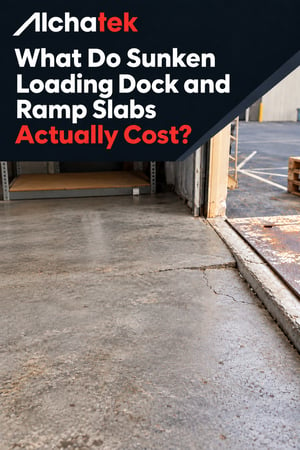
A sunken loading dock or ramp slab does not fail all at once. It drops a fraction of an inch at a time: a lip at the dock door, a dip in the apron where the trailers line up, a drive-up ramp that slowly pulls away from level. By the time it is obvious enough to put on a work order, the slab is no longer the only cost. The cost of a sunken loading dock or ramp slab is measured in forklift and trailer downtime, damaged product, a dock leveler that no longer seats against the trailer, and the liability of a trip hazard in the busiest few feet of the building. Every one of those climbs while the concrete sits.
Here is what the numbers actually look like, and why lifting the slab may very well be more effective than replacing it.
What Causes a Loading Dock or Ramp Slab to Sink
The slab itself is rarely the problem. What fails is the ground underneath it, and a loading dock sits on some of the most vulnerable ground on the whole site. A raised dock is built on deep engineered fill placed behind the dock wall during construction. If that fill was never compacted to spec, it keeps consolidating for years, under its own weight and under everything that drives over it.
Water makes it worse, and the apron is exactly where water collects. Roof downspouts, trailer wash-down, and poor site drainage all concentrate runoff where the trucks park. Moving water carries the fines out of the subgrade and leaves voids behind. Once a void opens, the slab is spanning empty space instead of bearing on soil.
Then there is the load. A dock apron and a drive-up ramp take the heaviest, most repetitive loads in the building: fully weighted trucks, loaded forklifts, and trailer jacks hitting the same few feet of concrete thousands of times a year. Over a void, that traffic pumps the slab like a see-saw, driving it further out of level with every pass, chipping the joints and widening the gap underneath. On a ramp, even a small drop changes the slope and the approach angle. At the door, it drops the slab below the dock leveler, so the plate no longer meets the trailer bed and loads have to bridge a lip. The settlement does not stabilize on its own, because the loads that caused it come back every shift.
Why Patching the Lip Doesn't Last
Grinding the lip, feathering an asphalt patch, or pouring a thin cap all improve the surface for a while, which is why they are usually the first response. But a patch sits on the same unsupported base that let the slab drop in the first place. The void is still there, the traffic is still there, and within a season or two the patch cracks and the lip comes back.
There is a liability cost to the cosmetic fix as well. Under the ADA, a vertical change at a walking surface as small as a quarter inch is treated as a trip hazard that has to be corrected, and a loading dock is a pedestrian work area as much as an equipment lane. Painting or patching a known lip without addressing the cause can later be used to show that the owner knew about the hazard and chose not to resolve it. The repair has to reach the soil, not just the surface.
Cost of Inaction vs. Repairing It Right
The slab repair is the smallest number in this whole conversation. The expensive options are doing nothing and replacing the slab.
| Approach | All-In Cost | Time Out of Service |
|---|---|---|
| Lift it with polyurethane foam | Typically 30–50% less than a full tear-out once demolition, disposal, and downtime are counted, with no repour | Hours. High-density foam cures in minutes, so forklifts and trucks can roll the same day |
| Tear out and replace the slab | Up to $23 per sq ft for the concrete alone, plus $2,000–$6,000 for demolition and disposal, before a dollar of lost shipping time | Days to weeks. New concrete needs up to 28 days to fully cure |
| Do nothing | "Free" today | Indefinite. Trip and ADA exposure, dock-leveler misalignment, equipment and product damage, and recurring downtime compound until the slab is fixed |
Read the first two rows together. The replacement figure is for the concrete alone. The real number is that price plus demolition, disposal, and the days or weeks the dock sits closed while new concrete cures. Lifting is an all-in number measured in hours, with the dock back in service the same shift. For a facility that ships on a schedule, the downtime difference by itself is often larger than the entire repair invoice.
There is also a cost that does not show up on any repair estimate: a forklift accident. Forklift incidents are among the leading causes of death in warehouse environments, and a loading dock or ramp is where that risk concentrates. The danger is not always something a driver can see. A sunken slab or a ramp that no longer meets the dock is at least visible. The more dangerous case is a slab that has not settled at all but has a large void beneath it. It looks level and sound, right up until the weight of a loaded forklift finds the hollow underneath. We have seen forklifts break through slabs that showed no settlement whatsoever, only an empty void below. By the time the surface gives way, the cost is no longer a repair bill. It is an injury, a stopped operation, and a liability claim.
Why Contractors Use Alchatek for This
Stopping the problem means filling the voids and raising the slab without piling more weight onto soil that already failed, which is exactly what structural polyurethane lifting foam does. Alchatek's AP Lift foams are injected as a liquid through small holes drilled in the slab, then expand to fill the voids underneath and raise the concrete back to grade in a controlled, measurable way. For the heavy, repeated loads a dock apron and ramp take, a high-density product such as AP Lift 475 carries the weight. Where the fill behind the dock wall has failed at depth, that soil can be stabilized several feet down with the Deep Lock® process before the slab is ever lifted.
- Minimal disruption: a small jobsite footprint lets the dock keep working around the repair.
- Minimal downtime: traffic-ready in minutes, not days.
- No added weight on weak soil: the foam is a fraction of the weight of the slurry used in old-style mudjacking, so it does not re-load the ground that gave way.
- Precision: the slab is raised in stages and checked to grade, so the dock leveler seats again and the approach comes back smooth instead of overcorrected.
The positioning Alchatek gives its contractors is the one running through this whole article. You are not selling a few drum sets of foam. You are selling the operator their dock back: level, load-ready, and shipping again the same shift.
Continue Reading
- What Does a Settled Concrete Slab in a Warehouse Actually Cost?
- Foam Concrete Lifting: A Durable Solution for Sunken Slabs
- Sinking Concrete Slabs: Causes and Solutions
Get the Dock Back in Service
The cheapest time to lift a sunken dock or ramp slab is before the void spreads and the leveler drifts out of alignment. Talk to an Alchatek specialist at (404) 618-0438, or find a trained contractor near you.
Cost ranges in this article are industry averages drawn from published 2025–2026 concrete-leveling and slab-replacement cost guides. Figures represent typical repair and replacement pricing, not a quote; actual costs vary by site conditions, region, slab thickness, load, drainage, access, and severity.
Want more information on lifting slabs with polyurethane?

 Translate
