
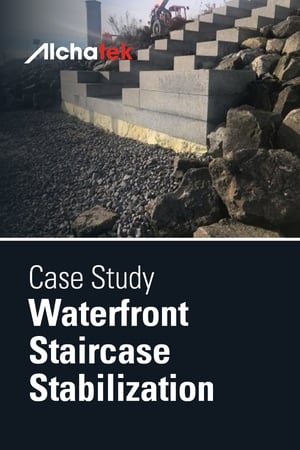
 A public park in New York had critical erosion issues at its waterfront staircase and adjacent beach, which were built over a landfill. Over the years, natural erosion pulled back sand, exposing uneven foundation areas and creating safety hazards for visitors. The partially buried concrete staircase exhibited significant subsidence and shifting soil, posing a threat to structural collapse. The New York City Parks Department required a rapid solution to stabilize the site before further degradation occurred.
Initial Assessment
The staircase and surrounding sand exhibited signs of differential settlement, likely due to uneven soil compaction and erosion. Technicians identified voids beneath the stairs and along the beachfront, with sand migration exacerbating instability. Traditional excavation or pier-and-casing methods were impractical due to limited access and the need to avoid displacing adjacent structures.
Proposed Solution
The team selected AP Fill 720 (a single-component polyurethane) for soil compaction/stabilization and AP 430 (a two-component foam) for structural void filling. AP Fill 720 addressed loose sand through permeation and consolidation, while AP Lift 430 filled critical voids beneath the staircase, providing lift and support.
Procedures
- Stabilization Pattern: Injected AP Fill 720 every 4 feet at 6–8 feet depth to bond sand particles and prevent further migration.
- Structural Foam Injection: Applied AP Lift 430 directly beneath the staircase’s granite slabs through strategic ports, filling void spaces with approximately 1 gallon per linear foot.
- Final Treatment: Reserved excess AP Fill 720 to seal surface gaps around the staircase, preventing sand washout.
Results
The dual-material injection rapidly stabilized the waterfront staircase, eliminating soil migration and structural risk without closing the park. Compared to traditional heavy reconstruction, the approach cut costs by an estimated 97% and completed the work in under two weeks with minimal marine or community disruption. Post-repair inspections confirmed lasting results with no recurrence of erosion.
Want more information on stabilizing soil with polyurethane?

 Translate