

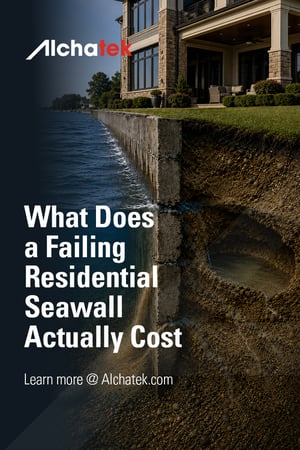
 A seawall rarely fails all at once. It starts small, a hairline crack near the waterline, a soft spot in the yard, a slight lean nobody notices until the pavers start pulling apart. The price of the fix grows every day you wait, because the damage behind the wall keeps progressing even when the surface looks stable.
What a Failing Seawall Actually Costs
There's no single number that fits every seawall repair, but the relative cost structure is predictable, and it's worth understanding before you call anyone.
Targeted repair, filling the voids and stabilizing the soil behind the wall, is by far the least expensive path when caught early. Patch-and-repeat cosmetic fixes look cheap on any single invoice, but they don't stop the underlying erosion, so the cost adds up every time you have to call someone back. Full demolition and replacement sits well above both, often by a wide margin, because it involves permitting, heavy equipment, and rebuilding the structure from the ground up rather than restoring what's already there.
That gap between options is significant enough to change how a homeowner should think about a small crack today: fixing it now, while it's still a targeted repair, is not a close call against waiting until it becomes a replacement.
Exact costs vary by region, wall material, soil conditions, and severity. A trained contractor can give you an accurate number after a site evaluation.
The Root Cause: Why Seawalls Fail From the Inside Out
Most seawall problems don't start at the wall. They start behind it.
As water levels rise and fall against the wall, whether from tides, wave action, storm surge, or seasonal water table changes, water pushes through cracks, joints, and defects on the way in and pulls sand and soil out with it on the way out. Over time, this cycle hollows out voids behind the wall that nobody can see from the surface. Heavy rain speeds it up. Clogged weep holes and vents make it worse, trapping pressure that has nowhere to go except through the wall itself.
By the time a sinkhole appears in the yard or a section of wall visibly leans, the soil loss behind it is usually already extensive. Wall age, soil type, drainage, and storm exposure all affect how fast this moves, which is why two similar-looking walls can be at very different stages of failure.
Do Nothing, Patch It, Replace It, or Repair It Right
The instinct with a small crack or minor void is often to wait. But seawall damage compounds. A problem that starts as a localized void becomes a larger stability issue as soil continues to migrate.
| Approach | What It Typically Involves | Long-Term Outcome |
|---|---|---|
| Do nothing | No action while cracks and settling continue | Soil loss accelerates, raising the risk of collapse and property damage |
| Patch-and-repeat | Surface-level cosmetic repairs without addressing voids behind the wall | Appearance improves temporarily; underlying erosion continues |
| Full replacement | Demolish and rebuild the wall | Solves the visible structure but not necessarily the drainage or soil issues that caused the failure, and carries the highest cost and disruption |
| Targeted repair | Fill voids, stabilize soil, and seal points of water intrusion | Restores structural support without full demolition, when site conditions allow |
The right path depends on how far the damage has progressed and whether the wall itself is still structurally sound. A proper site evaluation, not a guess from the yard, should always come first.
Why the Right Contractor and the Right Material Matter
Not every repair method is right for every wall, and this is where a lot of homeowners get burned. Some contractors default to aggressive, rigid two-component foams because they're fast and inexpensive to install. On the wrong wall, especially one with limited structural capacity or a lot of existing movement, that rigidity and expansion force can do more harm than good. In some documented cases, an overly aggressive two-component fill has blown a wall completely out rather than stabilized it.
Alchatek factory-trained contractors are taught to match the material to the wall, using flexible, hydrophobic single-component resins for void fill and soil stabilization in most residential applications, reserving higher-density two-component products for situations where they're actually appropriate. Some of these resins are certified to NSF/ANSI 61 for contact with potable water, a specific, third-party-verified standard covering leaching and health effects, though that certification speaks to potable water contact and doesn't by itself confirm performance or safety in a saltwater or marine setting. Confirm the specific certification for any product on its technical data sheet.
This is exactly why the contractor matters as much as the product. Filling a void and sealing the points of soil loss is only part of the job. Choosing a resin that fits the wall's condition, the soil, and the water environment is the rest of it, and that judgment comes from training and experience, not from a price quote.
Find a Trained Contractor Before You Have a Bigger Problem
Small cracks, soft spots in the yard, or a wall section that's slightly out of alignment are worth a professional look now, not after the next storm. An Alchatek factory-trained contractor can evaluate the site and recommend a repair matched to your wall's condition, rather than a one-size-fits-all fix.
Continue Reading
Seeing Signs of Trouble?
Small cracks, soft spots in the yard, or a wall section that's slightly out of alignment are worth a professional look now, not after the next storm. Talk to an Alchatek specialist at (404) 618-0438, or find a trained contractor near you.
Want more information on geotech products and equipment?

 Translate