

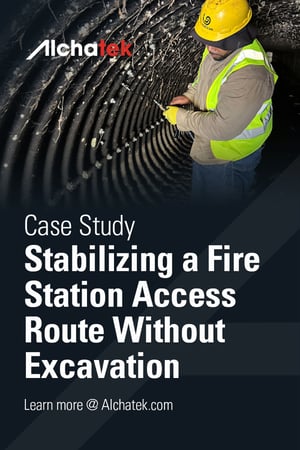
 The Clearwater Fire Station faced a growing infrastructure threat. Cracks began appearing across the asphalt driveway leading into the station, a critical access route used daily by emergency vehicles.
These surface defects were symptoms of a deeper problem: void formation and soil loss beneath the roadway caused by a compromised storm drain system. The underground piping was deteriorating, with gaps in storm drain seams allowing surrounding soil to wash into the system during heavy rain. Over time, this erosion created voids beneath the pavement, jeopardizing both the integrity of the roadway and the safety of emergency operations.
Leadership at the station knew a surface patch was not enough. The solution had to address the underlying soil instability and protect the structure long-term.
Initial Assessment
Stabilizing a storm drain without full excavation is a technical and precision-driven task. Three constraints shaped the approach:
- Access. The fire station driveway had to remain operational for emergency vehicles.
- Material placement control. Injection had to reinforce the drain without blocking water flow.
- Soil reconsolidation. The solution needed to fill voids beneath the road surface to prevent further settlement.
Traditionally, this repair would involve removing the roadway, excavating down to the storm drain, and replacing the system entirely. While effective, that approach can take weeks or months, cost significantly more, and still risk seam misalignment in the future, restarting the erosion cycle.
Proposed Solution
Helicon selected AP Fill 700 designed for deep soil permeation and water resistance. The material flows into fine cracks and joints inside the storm drain, seals gaps to prevent further soil loss, and bonds with surrounding soils for long-term stability.
The approach stabilized the system from the inside out, avoiding excavation.
Procedures
- Placed injection points to cover the compromised zones
- Injected AP Fill 700 and around the storm drain
- Allowed the resin to flow upward into surrounding soil layers, sealing the drain structure while recompacting soils supporting the roadway
- Pumped 237 gallons of polyurethane resin across the affected area
- Filled voids and formed a monolithic, water-resistant barrier
- Confirmed the stabilized subgrade could carry heavy fire apparatus and daily traffic
Results
- Restored roadway safety without excavation
- Extended the lifespan of the storm drain and pavement
- Prevented further erosion and void formation
- Completed the work quickly, with no operational downtime for the fire station
- Left the station with a fully stabilized access route capable of supporting heavy use
Want more information on soil stabilization?

 Translate