
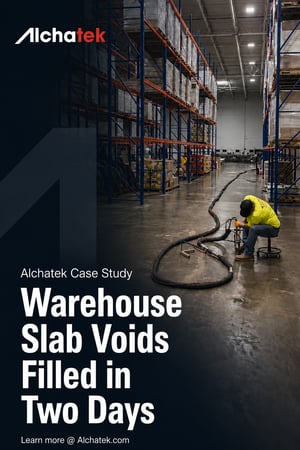
 A long crack running through the floor of a high-traffic medical supply warehouse in Memphis signaled a problem below the slab. With forklift traffic and heavy racked storage running daily, and the building staying operational throughout, the team needed to know what was happening underground before choosing a repair method.
Initial Assessment
Ground penetrating radar (GPR) scans identified voided areas roughly 10 to 20 inches below the slab, confirming the crack wasn't just surface wear. Soil had shifted or washed out beneath the concrete, leaving sections of the slab unsupported. Removing and replacing the affected concrete would have meant disrupting warehouse traffic, adding downtime, and extending the repair window well beyond what the facility could accommodate on a live operating schedule.
Proposed Solution
Mid-South Concrete Lifting selected AP Lift 475, a two-component, high-density structural polyurethane, to fill the voids beneath the slab without removing any concrete. The product's expansion behavior, reacting to fill irregular void shapes rather than settling flat, made it a fit for reaching uneven cavities and re-establishing contact with the underside of the slab. This approach kept the facility in service throughout the repair.
Procedures
- Located the crack and mapped suspected void zones
- Staggered injection points along both sides of the crack
- Covered approximately 450 linear feet
- Drilled injection holes through the slab
- Injected polyurethane to fill the voids
- Monitored slab response throughout injection
Results
- Completed the project in two days
- Minimized disruption to warehouse operations
- Filled voids without slab replacement
- Improved support beneath forklift traffic areas
What This Means for Similar Projects
Void fill worked here because the slab itself was in good enough condition to stay in service and the underlying issue was a void rather than a structural failure in the concrete. That won't hold true on every job. Deteriorated or delaminated concrete, active water intrusion, poor bearing soil, or a drainage source that's still feeding the erosion can all change which repair approach actually makes sense. GPR or another subsurface assessment is generally the step that determines that, not the crack itself.
As a general point of reference, industrywide, full removal and replacement of an industrial slab tends to run well above void fill injection on a cost basis once demolition, disposal, and downtime are factored in. That gap varies by region, access, traffic control requirements, and the extent of the voiding, so it's not a number to lean on without a site-specific estimate.
The Role of a Technical Partner
This job was completed by Mid-South Concrete Lifting, a contractor experienced in polyurethane slab lifting and void fill work. On projects like this, Alchatek's role is providing the product knowledge and technical backup that help a contractor match the right polyurethane system to the void size, load, and site conditions, and staying available for tech support once the crew is on-site.
If you're weighing void fill, slab lift, or another repair method for a project you're looking at, Alchatek's tech support team can walk through the site conditions with you before you commit to an approach.
Want more information on geotech products?

 Translate