
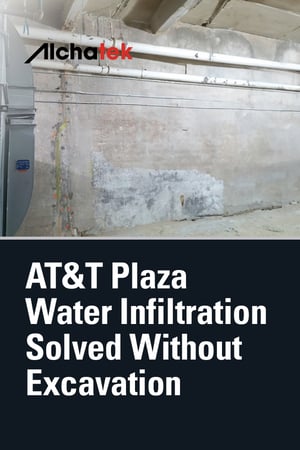
 AT&T Plaza in downtown Dallas had persistent water infiltration issues in its basement and sub-basement levels, resulting in structural concerns and operational disruptions. The building's below-grade concrete walls developed multiple active leaks, allowing groundwater to penetrate the structure and causing dampness at wall-floor transitions, which raised concerns about potential corrosion of the reinforcing steel. Building management required an immediate solution that would effectively seal the leaks while minimizing disruption to commercial operations.
Initial Assessment
Engineering inspections by B|S|A Design Group revealed multiple active leak points throughout the basement and sub-basement concrete walls, with water infiltration occurring through cracks, joints, and penetration points. The moisture intrusion patterns indicated that several leak locations had been active for an extended period. Traditional waterproofing methods would require extensive excavation and reconstruction, making them impractical for a busy downtown commercial building. The assessment concluded that targeted injection would be most effective while allowing the building to remain operational.
Proposed Solution
The engineering team specified Spetec PUR F400, a hydrophobic polyurethane grout designed for water cut-off applications in concrete structures. This single-component material was selected for its ability to react with water to form a flexible, closed-cell polyurethane seal that permanently stops water infiltration. The material's low viscosity allows deep penetration into crack networks while its hydrophobic nature ensures effective sealing in wet conditions. This approach would eliminate disruptive excavation while providing a permanent solution.
Procedures
- Engineers identified and mapped all visible leak points, prioritizing the most severe infiltration locations.
- Injection ports were drilled at strategic locations to intersect water migration pathways through the concrete structure.
- Spetec PUR F400 was mixed with appropriate catalyst ratios and injected using controlled pressure techniques.
- Technicians monitored for complete crack filling and leak cessation, with post-injection inspections confirming successful sealing.
- Work was coordinated to minimize disruption to building tenants throughout the process.
Results
The injection process successfully eliminated all water infiltration throughout the treated areas. Post-repair monitoring following significant rainfall events confirmed the complete cessation of leaks, with previously wet areas remaining dry. The project was completed with minimal disruption to building operations. The injection approach achieved 98%+ cost savings compared to traditional excavation and membrane installation methods. Additionally, avoiding a building evacuation prevented an estimated $25,000-$ 50,000 in lost rental income and tenant relocation costs.
Want more information on polyurethane leak seal products?

 Translate